
A scientific study
A simple idea, that lead to a revolution
By Bronisław Łosiewicz
Firmalampen, known also by a misleading English name of “factory lamps”, born in Po Valley (Northern Italy) in the area of Modena during 1st quarter of the 1st century AD, from where the production spread mainly north- and westwards to Gaulle, Rheinland and Britain, but also to Slovenia, Slovakia and further to the province Moesia, extending the lifespan of the type, mainly thanks to copies, in some lands up till the 4th century AD.
1. Technological masterpiece
Commonly used by people of some European provinces, unknown or barely traceable in other, Firmalampen were a product that hugely preceded any formal mentions of so-called “double oxygenation”, which was patented by Ami Argand in late XVIII century!
How does it work then?
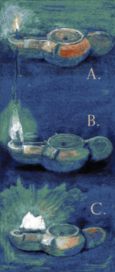
As visible on Fig. 1., there were 3 basic ways of using the Firmalampen.
Method A. shows us a usage of such lamp, as any other, with basic lamp luminance.
In method B., we have the wick pulled up, from the lamp, which in exchange enhanced the flame power by about 50%.
As can be observed by the visualization of method C., the flame power is even greater, toping at about twice the basic lamp luminance. This was achieved by pulling the wick over the nozzle-channel, highlighted on Fig. 2., thanks to what the flame was getting oxygenated from both bottom – through a small opening in the nozzle-channel, from inside the lamp, but also from the top.
Better luminance, came of course at some cost, increased consumption of oil, increased by 50% in case of method B. and by 100% in case of the method C.
This was a huge breakthrough which allowed for better quality lighting, which allowed certain jobs to be done after sunset.
Fig. 1. Three ways of use of the Firmalampen (© C.-H. Wunderlich, 2006)
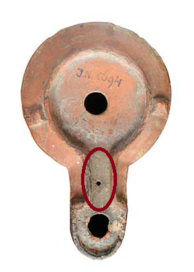
Fig. 2. Example of Firmalampen with highlighted nozzle-channel.(© S. Sakl-Oberthale, C. Ranseder, 2016)
2. Typological differentiation
The term Firmalampen is usually associated with a small group of predefined patterns, catalogued by and named after the typology on the lamps of Vindonissa elaborated by German scholar – Siegfrid Loeschcke. The Loeschke type IX and X lamps were made to do exactly one thing – give light, but more extensively and intensively than the other contemporary constuctions.
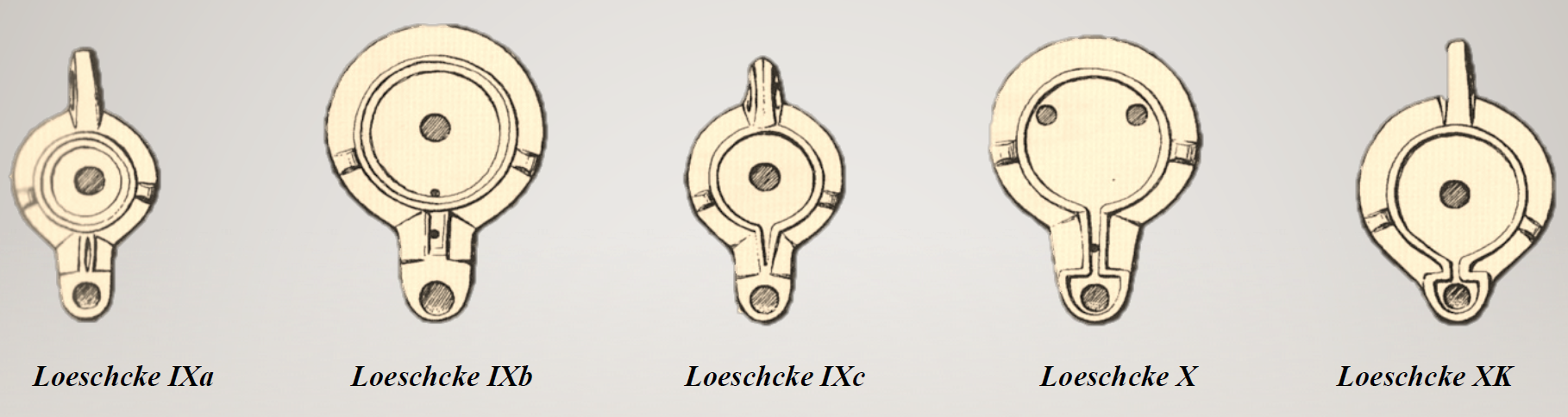 Fig. 3. Basic representation of Firmalampen subtypes according to Loeschcke. (© L. Chrzanovski)
These lamps were supposed to be quick and easy to produce and transport-resistant, to survive long-distance travel, thus the main lychnological difference between the different types is mainly in size and shape. Going from left to right:
- Loeshcke IXa – nozzle has a closed -in, narrow and shallow linear groove, often with two serif ends, divided from the discus area by a thick rim;
- Loeshcke IXb – continuous discus rim, most of the time a handle, deep and wide groove on the beveled nozzle top, between the discus rim and the flat raised nozzle tip, base marked off by two rings, the outer one bigger than the inner one;
- Loeshcke IXc – V-shaped groove, open in the upper end towards the discus, but remains separate from the wick hole on the lower end of the nozzle;
- Loeshcke X – prolongation of the discus rim down the nozzle to the tip, thus making a broad open channel between the discus and the wick-hole area, depending on the region of production they appeared either with or without an airhole in the nozzle channel;
- Loeshcke X Kurz (or shortly XK) – main difference between lamps of this subtype and the other group of type X is a circular basin with a short nozzle.
3. Place of origin and where it spread
As earlier mentioned, Firmalampen origin in the Po Valley, more specifically in area of Modena during the 1st half of the 1st century AD. The area originally known for production of “Pergamon” replicas, swiftly transitioned to mono-production of Firmalampen. The most recognized workshops of Strobilus, Fortis gained much popularity, which resulted in creation of first branches in areas of Venice and Friuli and in Slovenia. Soon after branches in Gaul in the area of modern-day Lyon and South France were created.
During the 2nd half of the 1st century some of the originators of Firmalampen production quit Modena. Looking for recognition in other parts of the empire they travelled to Aegyptus and Levant, where they adapted their production to local needs, abandoning the Firmalampen.
Meanwhile the popularity of the Firmalampen grew in the northern part of the empire, especially along the Rhine and the Danube limes, but also in Britain and Crimea and even Gonio {Apsaros) the easternmost Roman castrum, in nowadays Georgia . Thanks to the sturdy structure the lamps were easy to transport and the luminance they gifted, they were ideal for use in military outposts and castra legionis where they were mostly utilized. As a result the army quickly adopted them to their use and also coordinated some local production near the castra.
4. Summary
The Firmalampen were the typical lamps that didn’t reach the higher echelons of Roman society, which from the beginning wasn’t the aim. They were created to allow the “working class” to do their jobs after sunlight granting them better luminance. The revolutionary method of use and easy and repeatable mold production allowed them to spread all over the northern parts of the empire. Many of the aspects of the Firmalampen are still researched and new facts are unearthed year by year.
Main Bibliography
Bussière, J. & Lindros-Wohl, B. Ancient Lamps in the J. Paul Getty Museum, J. Paul Getty Museum, Los Angeles, 2017
Chrzanovski, L. Firmalampen: An abundantly-produced lamp-type almost never used? Socio-economic elements to define a new framework to study these peculiar lighting devices, pp. 215-262, 2020
Frecer, R. Gerulata: The Lamps, Charles University in Prague, Karolinum Press, Prague, 2015
Sakl-Oberthaler, S. & Ranseder, C. Massenware: Lampen aus der Form, Stadtarchäologie Wien, Vienna, 2016
Wunderlich, C.-H. , Appendice 1: Archéologie expérimentale. Eclairage antique high-tech, in Chrzanovski, L. (ed.), Lumière! L’éclairage dans l’antiquité. Catalogue de l’exposition itinérante – Nyon, Olten, Avenches, Nîmes, Millau 2003-2006 – 2e édition, revue et augmentée, Milan, pp. 40-45 , 2006